Bison & Basic Being

Yellowstone National Park is primarily located in the northwest corner of Wyoming, USA with small strips of land inside of Idaho and Montana. Covering 3,500 square miles, it is approximately 54 miles wide from east to west and 63 miles long from north to south. The park sits on top of the Yellowstone Caldera which is the largest super volcano on the continent. Home to over 500 active geysers (half of the world’s total), Yellowstone also has the planet’s largest concentration of geothermal features including hotsprings, mud pots and steam vents.
Mudpots are acidic features with a limited water supply. Microorganisms convert hydrogen sulfide gas coming up from deep within the earth to sulfuric acid, which breaks down rock into clay minerals.
When rumors of this magical place were heard by 19th century Americans eager to settle the west they were taken as delusions and fictional tales until several formal expeditions were organized to explore the area. With significant lobbying from the Northern Pacific Railroad, president Ulysses S. Grant signed the Yellowstone National Park Protection Act in 1872 establishing Yellowstone as the country’s first national park. With westward expansion driven by the pursuit for profit, the park’s creation created a booming tourist industry that relied exclusively on trains for transportation.
Before Euro-Americans settled Turtle Island, there were millions of Indigenous people who lived with the land and had for many thousands of years. The modern park boundary of Yellowstone has ancestral connections with dozens of Native American tribes who used this area for hunting, gathering, trade and ceremony. In the oral traditions of the Crow, Shoshone, Blackfeet, Flathead, Bannock, Nez Perce and others, they knew Yellowstone country as “land of the geysers,” “land of the burning ground,” “the place of hot water,” “land of vapors” or “many smoke.”1
From 1776 to 1887, the U.S. government took over 1.5 billion acres of Native American land during their ideological drive for Manifest Destiny. In the early years of Yellowstone, the U.S. Army took control of the park which included forcibly excluding and displacing Indigenous tribes from their traditional hunting and sacred grounds. The government’s systemic Indigenous dispossession included the near-extinction of the American bison/buffalo as a solution to “settle the Indian question”.
“In the end, the frontier army’s well-calculated policy of destroying the buffalo in order to conquer the Plains Indians proved more effective than any other weapon in its arsenal. . . With the mainstay of their diet gone the Indians had no choice but to accept a servile fate on a reservation where they could subsist on government handouts. From the Indian perspective the buffalo’s disappearance was a shattering blow. Crow Chief Plenty Coups described its impact. . . When the buffalo went away the hearts of my people fell to the ground, and they could not lift them up again. After this nothing happened. There was little singing anywhere.”2
By the late 1880’s the bison, the largest land mammal in North America that once roamed freely across the continent in numbers that reached into the tens of millions, dwindled to about two dozen in the Yellowstone area. Simultaneously, the genocide of Native Americans by the U.S government was underway in the west, with more than 200 years invested in the ethnic cleansing since the arrival of the first colonial settlers. By 1900 their population was reduced by 90% to number less than 250,000 people. The fate of the people and the bison were the same- the people, the bison and the land are an intertwined system of life.
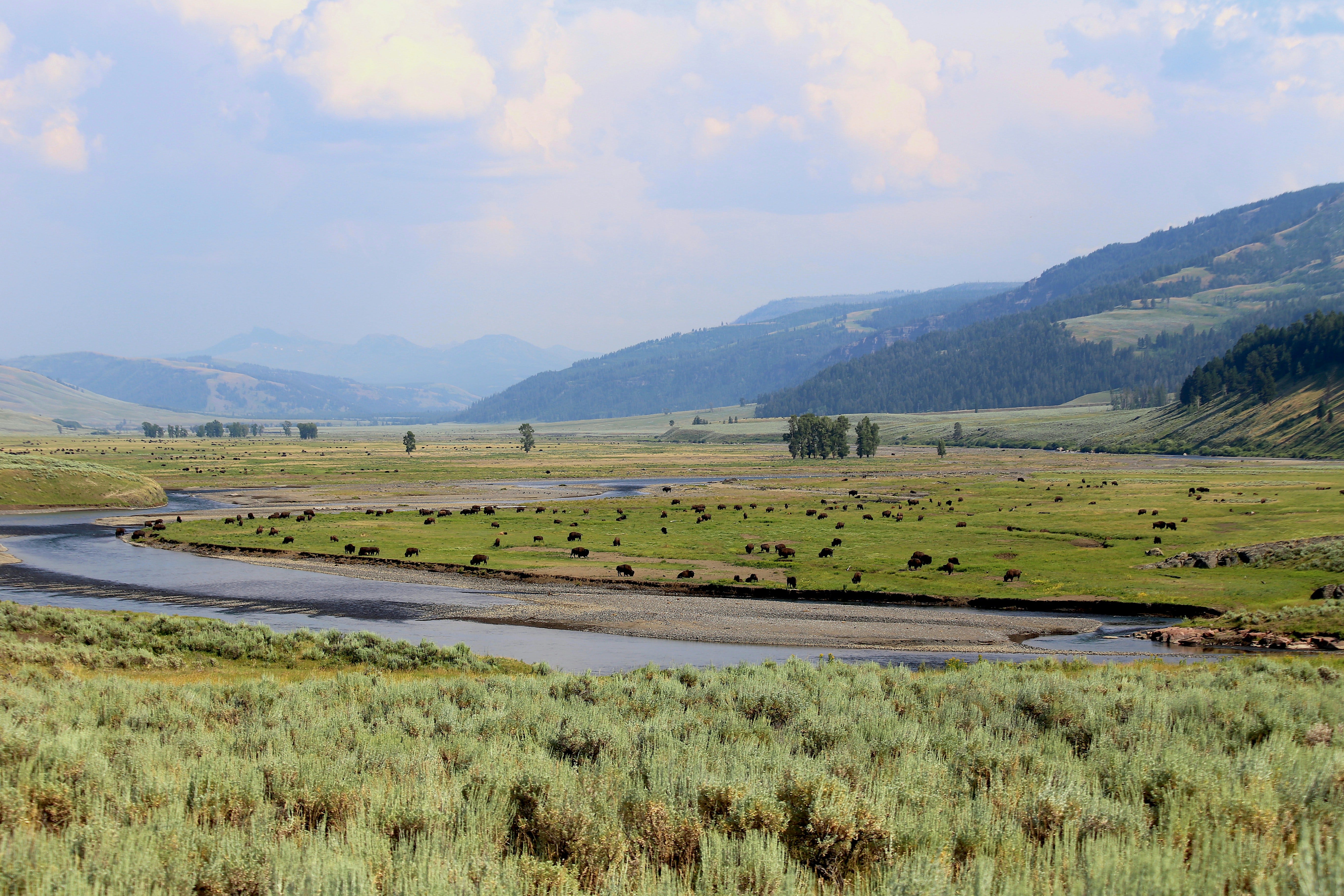
Buffalo herd in the Lamar Valley, Yellowstone National Park
Today in the U.S. there are 575 federally recognized Indigenous nations and approximately 30,000 wild, free-ranging bison. In Yellowstone National Park specifically, there are about 5,300 bison who are direct descendants of the only population to live continuously in the U.S. since prehistoric times. The 150th anniversary of Yellowstone National Park in 2022 acted as a catalyst amplifying calls for tribal engagement and tribal representation. David Treuer, an Ojibwe author and historian, argues that the American West “began with war but concluded with parks” and declares “it’s time they were returned to America’s original people.” Although the park has shifted to include tribal perspectives on the landscape, the park’s history of genocide and land theft is still hiding in the shadows. Dina Gilio-Whitaker, descendant of the Colville Confederated Tribes and author says, “This is unsettling work, talking about decolonizing and unsettling the settler state. It means making people uncomfortable, inevitably, but we have to have these uncomfortable conversations.”3
While I was visiting the park this past weekend I thought about Yellowstone’s first people, their connection to the land and how body is land.
Yellowstone includes an incredibly diverse landscape with geothermal areas, jagged peaks, lush forests, alpine tundras, mountain meadows, winding rivers and sagebrush-steppe grasslands. The area has over 1,400 native plant species, 300 species of birds and 16 fish species. The park is home to the largest concentration of mammals in the lower 48 states including not only bison but also bighorn sheep, elk, moose, mountain goats, pronghorn, deer, black bears, grizzly bears, coyotes and wolves. Their concentrated population offered the gift of seeing every one of these animals, except wolves, in 3 days!
The sense of time transformed in the presence of land being land. While at Artist’s Point, the most southern part of the Grand Canyon of the Yellowstone, I overheard someone say to their traveling companion, “If only I could bottle this up and take it home!” I get that. The experience of being immersed with nature is like a bath for the spirit and a song for the soul.
Artist’s Point, Grand Canyon of the Yellowstone
I also considered how we don’t need to “take it home” because this felt-sense experience is home, it’s happening within. The knee jerk reaction to “take it home” is testament to the behavioral engine of human consumption as a way to remedy discomfort. If I have X, I will feel better. When I achieve X, I will be happy. Yet, looking around it’s easy to see that owning all the things, having all the treats, getting all the accolades and removing all the wrinkles doesn’t change the desire for more. Satisfaction cannot be found in the world of red dust.
The direct experience of being with the waterfall and river, the canyon and rocks is like an invitation to return to what has always been, already is- home. The land itself calls forth the presence of being that sits behind personality, identity, self. And there appears something more fundamental. Something basic is realized that is inherent in you and yet does not belong to you. And although Artist’s Point can resonate its place within, there is no outside requirement for coming home to being.
We spent hours sitting with the bison herds. Binoculars to face, breath moving with the ground. Observing their grazing, sleeping, dust bathing, playing and moving. New born calves nursing and finding their legs. My awareness distributed through the landscape to see and listen and learn. In the process, my own internal compass shifted orientation. The part of me that is back, back, behind a name, beyond a form, came forward. The bison reflected to me, there is no me, just basic reality moving though body and land.
Imagine if humans spent more time exploring their inner landscape and developed a map to locate being home. There would no longer be the desperate need to consume everything around us forever because we would be filled with satisfaction.
Want to dive deeper into this landscape of embodied cognition?
Join darius/dare carrasquillo and me next Friday May 15th